Skip to content

ACVECC Congress Call for Speaker Proposals
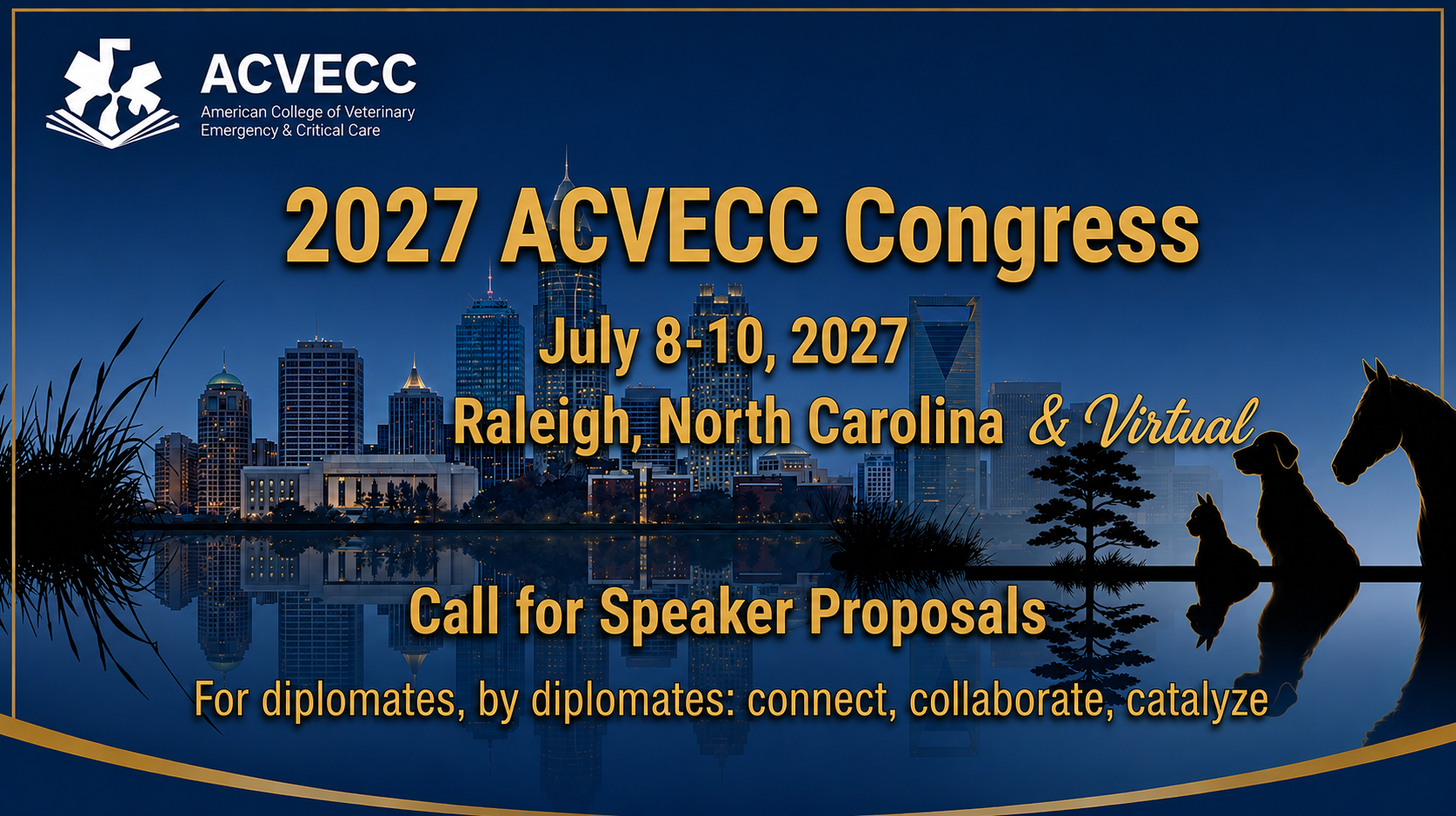
July 8–10, 2027 
McKimmon Conference and Training Center at NC State University in Raleigh, NC | Virtual

Click here to submit your speaker proposal!

Mission of the ACVECC Congress
An annual conference where ACVECC diplomates connect, learn, and collaborate at the specialist level, catalyzing innovations and translational partnerships that move veterinary ECC forward.

2027 Theme: Community and the Future of the Criticalist
The 2027 Congress format and feel of the event will work to bring Diplomates and others together and to represent where ACVECC is going.

Key Dates

  • Submission deadline: September 30, 2026     
  • Decisions announced: November 23, 2026

What We Are Looking For
While attendees will join us in-person and virtually, all selected speakers must be available to present in person at  the Congress to be held at McKimmon Training and Conference Center at NC State University in Raleigh, North Carolina.

All sessions are intended for a specialist-level audience. Successful proposals will:

  • Offer advanced, evidence-informed content
  • Challenge current thinking
  • Encourage interaction  
  • Provide practical strategies or insights attendees can apply in clinical practice, research, education, or leadership

We welcome presenters from other specialties or fields whose expertise is relevant and who can present to a specialist-level audience.

Congress Planning Ad Hoc Committee
Annie Wayne, DVM, MPHD, DACVECC, Chair
Bobbi Conner, DVM, DACVECC
Kira Epstein, DVM, DAVS-LA, DAVECC
Rita Hanel, DVM, DVM, DACVECC, DACVIM (INT MED)
Kelly Hall, DVM, MS, DACVECC
Alex Lynch, BVSc(Hons) DACVECC MRCVS
Deb Silverstein, DVM, DACVECC

Questions?
Contact the ACVECC Office at office@acvecc.org 

Before submitting your proposal, take a moment to explore the session options, evaluation criteria, and speaker details below.

Suggested Presentation Topics
The topics listed below are suggestions. We warmly welcome proposals featuring additional innovative ideas and emerging areas.

  • AI and veterinary critical care

  • Coagulation

  • Critical care cardiology

  • Critical care neurology

  • Dialysis

  • Education or mentorship

  • Infectious disease and antimicrobial therapy

  • Leadership

  • Nephrology

  • Practice models and challenges

  • Sepsis

  • Team dynamics

  • Trauma

  • Ventilation

What we are looking for:

All accepted sessions are intended for an advanced specialist-level audience.

Key Criteria for Strong Proposals:

  • Evidence-Informed Depth: Delivers advanced, high-level scientific or operational content.

  • Forward-Thinking Perspective: Challenges current paradigms and explores novel concepts.

  • Practical Application: Provides clear, actionable insights for clinical practice, research, leadership, or education.

  • Interactive Engagement: Features polling, discussion, or collaborative learning formats.

______________________________________________________________________________________________

Session Formats

Format Length Description & Example Ideas
Quick Hit 25 minutes

A space for provisional, contested, or newly formed ideas.

Example topics/formats:

• An idea for a future consensus statement

• Preliminary or negative data (abstract-style)

• A pathophysiology-heavy deep dive

• A description of a novel technique

• A practice-changing case study

• A close-read critique of a single paper

• A tool/method from another field adapted for ECC

• Something the field previously got wrong

• A well-framed, unanswered question for group discussion

Seminar 45 minutes A standard slide presentation. Live polling and active audience participation are strongly encouraged.
Workshop 90 or 120 minutes An interactive session where participants actively discuss, collaborate, or work through a hands-on topic.
Panel Discussion 90 minutes A group of experts led by a facilitator discussing a high-interest topic. (Max: 4 panelists + 1 skilled facilitator)

Alternative formats such as Panels and Workshops do the most to bring our community-driven theme to life and will be viewed favorably during the review process.

Key Dates

  • Submission deadline: September 30, 2026     
  • Decisions announced: November 23, 2026

Review Process Overview

  • All submissions will undergo a peer review by the ACVECC Ad Hoc Congress Planning Committee using a scoring rubric. A minimum of two (2)committee members will evaluate each submission.
  • The committee will then use rubric scores to rank submissions, while also weighing the overall balance of topics, formats, and planning feasibility across the program.
  • Committee members and their collaborators may submit proposals.
    • Any submission with a declared relationship to a committee member will be routed to reviewers without that relationship. The submission form asks you to disclose.

Proposal Evaluation Scoring Rubric

Each submission is evaluated across six core criteria scored on a 0 to 5 point scale, plus up to +2 bonus points for translational content.

#

Criterion

5 — Excellent

3 — Adequate

1 — Weak

0 — Does Not Meet

1

Goal & Relevance

(Why this, why now, why this audience?)

States a clear goal delivering specialist-level CE and/or providing meaningful connection around education, research, leadership, or clinical practice.

Goal is stated but only partially delivers on specialist-level CE or member connection.

No clear goal. Does not deliver specialist-level CE or foster connection. Fits any general veterinary CE event.

Criterion not addressed.

2

Quality of Content & Evidence Base

Demonstrates depth, accuracy, and command. Grounded in current evidence or expert opinion; pitched at the specialist level.

Content is sound but lacks depth or specificity. Evidence base present but not well articulated. Appropriate, but not pushing the field.

Content is superficial, inaccurate, or vague. No evidence cited. Pitched below specialist level.

Criterion not addressed.

3

Engagement & Format Fit

Session design promotes active participation, discussion, or collaboration. Format matches content to build connection.

Some interactive elements described. Format choice is reasonable but not optimized. Engagement implied, not planned.

Passive lecture with no interactivity. Format mismatch (e.g., 90-min panel for single speaker). Ignores audience experience.

Criterion not addressed.

4

Learning Outcomes

(What should the learner be able to DO?)

Attendees leave with actionable takeaways for specialist-level medicine, leadership, education, or research.

Outcomes are reasonable but generic. Some practical application implied; mostly aligned with description.

Outcomes vague or missing. No clear takeaway for attendees. Disconnect between outcomes and content.

Criterion not addressed.

5

Speaker Expertise & Experience

Presenter has clear expertise or unique perspective. Explicit qualification for a specialist audience; well-composed teams.

Presenter is qualified but not a standout choice. Limited track record but reasonable fit. Team composition adequate.

No evidence of expertise. Speaker background not provided or unclear. Team composition raises concerns.

Criterion not addressed.

6

Originality & Impact

Fresh perspective, new data, or novel approach. Potential to shift practice, thinking, or collaboration.

Familiar topic with a new angle. Incremental contribution; useful, but not likely to change practice.

Widely available content with nothing new added. Feels recycled. No discernible impact on the field.

Criterion not addressed.

+

Bonus Points (Up to +2)

+2 Points: Awarded for translational content—applies across species (large, small, exotic) and/or involves MD–DVM collaboration.


Event Details & Presenter Coverage**

  • Dates: July 8–10, 2027

  • Location: Raleigh, North Carolina

  • Attendance Requirement: Speakers must be available for on-site, in-person participation.

All accepted speakers receive complimentary Congress registration plus covered hotel stay within the official room block as outlined below:

Your Presenter Role Covered Hotel Nights Special Conditions & Details
Quick Hit Presenter 1 Night Standard presentation coverage.
Seminar Presenter 1 Night Standard presentation coverage.
Panel — Panelist 1 Night Standard panel participation.
Panel — Facilitator 2 Nights Reflects the additional preparation involved in leading and guiding the session.
Workshop Presenter 2 Nights Applies to both 90-minute and 120-minute workshops.
Multiple Presentations 2 Nights Applies to presenters delivering more than one session in any category.

**Maximum 2 Nights Per Person: The Congress takes place July 8–10, so coverage is capped at 2 nights per person, regardless of how many sessions you present.

What Is Not Covered
To assist with your travel planning, ACVECC does not provide:

  • Travel Expenses: Airfare, ground transportation, mileage, or parking to/from Raleigh

  • Independent Meals: Any food/beverage outside scheduled program meals

  • Honoraria: Speaking fees or honorarium payments

  • Extended Lodging: Hotel nights beyond your allocated 1- or 2-night coverage.

  • Call for Speaker Proposal Submission deadline: September 30, 2026     
  • Decisions announced: November 23, 2026